Maths > Abelian varieties > Finiteness theorems and the Faltings height
Shafarevich and Siegel's theorems
Posted by Martin Orr on Friday, 07 October 2011 at 09:00
In this post I will prove the Shafarevich conjecture for elliptic curves (also called Shafarevich's theorem). The proof is by reducing it to the finiteness of the number of solutions of a certain Diophantine equation, and then applying Siegel's theorem on integral points on curves.
Shafarevich's Theorem. Let
be a number field anda finite set of places of. Then there are only finitely many isomorphism classes of elliptic curves overwith good reduction outside.Siegel's Theorem. Let
be a number field anda finite set of places of. An absolutely irreducible affine curveoverof genus at leasthas only finitely many-integral points.

Since the reduction of Shafarevich's theorem to Siegel's theorem is short, and Siegel's theorem is of independent interest, most of the post will be about Siegel's theorem.
Proof of Shafarevich's Theorem
We can enlarge 



We can multiply the discriminant by any power of 12 in 


We just have to show that for each discriminant there are finitely many curves, but this is precisely the claim that

Roth's Theorem
The proof of Siegel's theorem is based on Roth's theorem on Diophantine approximation (also called the Thue-Siegel-Roth theorem). This limits how closely an algebraic number can be approximated by rationals, or more generally, by elements of a fixed number field 
Theorem (Roth, Ridout). Let
be a number field anda normalised absolute value on. Let. Ifis algebraic over, then there are only finitely manysatisfying


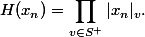
Here the absolute values are normalised so that they satisfy the product formula


Applying the theorem to the coordinates of points of a 
Theorem. Let
be a variety overand. Ifis algebraic over, then there is no infinite sequenceof points insuch that



Here 




The approximation theorem for abelian varieties
If 


![[m]^* V](http://www.martinorr.name/blog/images/mathtex/1481.png)


Theorem. Let
be an abelian variety overand. Ifis algebraic over, then there is no infinite sequenceof points insuch thatProof. Let
be a large integer, which we will choose later.By the Mordell-Weil theorem,
is finite, so there is an infinite subsequence ofcontained in a single coset. Pass to such a subsequence and choosesuch that. (We use Mordell-Weil, and the maprather than just, to ensure that the pointsare defined over.)Because
is compact, there is a subsequence ofwhich converges, say to. Then; this implies thatis algebraic over.The map
is finite étale, so there is a constantsuch thatfor all large enough. So by hypothesis,Because the log of the height is a quadratic form on an abelian variety (up to constant error), we have that for large
,So
Choose
large enough thatand we get a contradiction of Roth's theorem.








The same theorem also holds if 
Siegel's Theorem
Theorem. Let
be a number field anda finite set of places of. An absolutely irreducible affine curveoverof genus at leasthas only finitely many-integral points.Proof. Without loss of generality we may assume that
is nonsingular (otherwise cover it by its desingularisation).Suppose that
contained an infinite sequenceof integral points. Letbe a coordinate function on. Thenis an-integer for all.Let
be the union ofwith all the archimedean absolute values of. Sinceis an-integer (i.e.for all), we haveIt follows that there is some
such thatfor infinitely many, where.Replace
by a subsequence satisfying this inequality, then by a subsequence converging to some.By Northcott's theorem,
as, so also. Henceis a pole of, say of order. Soas.So we have
for largeand some constants,, which contradicts the approximation theorem.






Historical note
The theorem as proved by Siegel applied only to ordinary integers, not
Mahler extended the Thue-Siegel theorem to non-archimedean absolute values in 1935, allowing him to prove finiteness of 
Broad Question: To what extent can the methods in this post be used to prove the Shafarevich conjecture for higher dimensional abelian varieties? Can it be descended to some analogue of Siegel's theorem? After all, the approximation theorem works for any abelian variety, and you're not using the full strength of this in your proof of Siegel's theorem (in your penultimate section (before the historical note)). Maybe the approximation theorem will imply this (yet-to-be-determined) analogue of Siegel?
If the answer is no, then where is the hurdle? (I guess that the answer is 'no', because otherwise there would have been no need for Finiteness I and the bulk of Faltings's work for Mordell; perhaps the methods of Finiteness I are of themselves a generalisation of the tools of this post?)
Other comments: In the "Proof of Shafarevich's Theorem" section, is it worth highlighting that


What's the next post about? Let me guess...either you start on Finiteness I, or you deduce Mordell from Shafarevich for curves. Either way, I'm really enjoying this series of posts (I daresay, more than the previous series!)
By the way, I'm going to Cambridge for that Part III prospects thing in October; are you going? If you'd like to come to Warwick, you'd be more than welcome to stay over. And I saw recently that in November there is a series of lectures in commemoration of Shiing-Shen Chern at IHES; will you go?
First of all the fact that the Shafarevich theorem can be deduced from Siegel's theorem seems like a bit of a coincidence to me - it is an argument about Weierstrass equations rather than about elliptic curves. I don't think that this can be generalised to higher dimensions, and Faltings' proof of Finiteness I had nothing to do with Siegel's theorem.
This is not the only way of deducing Shafarevich's theorem from Siegel's theorem. There is a more geometric one by applying Siegel to the modular curve


In the proof of Siegel's theorem, I should probably have pointed out the reason why it does not work for abelian varieties, since the approximation theorem does. It is when we talk about


Faltings proved finiteness of integral points on an affine subset of an abelian variety in 1990. This was related to a new proof of Finiteness I due to Vojta in 1989, which starts by unpacking the proof of Roth's theorem, but involves much heavier machinery like the arithmetic Riemann-Roch theorem as well. For more on this, look at Chapter IX of Lang's book "Number Theory III", volume 60 in the Encyclopedia of Mathematical Sciences series; a later edition was published under the title "Survey of Diophantine Geometry".
My next post will be on Siegel's theorem for curves of genus zero with at least 3 points at infinity and Baker's theorem, which gives effective bounds for some cases of Siegel's theorem. This is not really an organised series of posts, and I certainly do not intend to go through the whole proof of Finiteness I. But I will look at some of the ideas involved, particularly in the Masser-Wüstholz proof, which gives an effective bound in Finiteness I.
Thanks for the correction. Yes I am going to the Part III afternoon (in November). I did not know about the Chern lectures until you told me.