Maths > Abelian varieties > The Masser-Wüstholz isogeny theorem
The matrix lemma for elliptic curves
Posted by Martin Orr on Friday, 25 May 2012 at 14:00
Let 


The matrix lemma says that, if
Matrix lemma. (Masser 1987) Let
be a principally polarised abelian variety of dimensionover a number field. Letbe the period matrix forin the standard fundamental domain of the Siegel upper half space. There is a constantdepending only onsuch that all the entries ofsatisfy
![\lvert \mathop{\mathrm{Im}} \tau_{ij} \rvert \leq c [K:\mathbb{Q}] \max(1, h(A)).](http://www.martinorr.name/blog/images/mathtex/1168.png)
Last time I used a lower bound for the lengths of non-zero periods in the proof of the isogeny theorem. This follows from the matrix lemma as we can easily relate lengths of periods and the period matrix.
Today I will prove the matrix lemma for elliptic curves. The general proof requires various facts about Siegel modular forms and also uses a funny choice of level structure due to Igusa (I do not understand why). But the basic structure of the proof is already visible in the elliptic curves case and we can be concrete about the modular forms involved, using only facts I learned in Part III.
A note about heights
The lemma is valid taking 


I was a bit disappointed when I realised this because I had thought that the Masser-Wüstholz isogeny theorem gave a proof of Finiteness Theorem I independent of Faltings' work. Of course the comparison between heights is not all of Faltings' proof, but according to Milne, "Technically, this is by far the hardest part of the proof."
In order to define the height of a point in the moduli space we need to choose an embedding of the moduli space into projective space. I think we have to choose the right embedding for the lemma to work (and also for the comparison with the Faltings height to work) but I am not very clear about that -- I think this might be related to the Igusa level structure which I mentioned.
For today, I am sticking to elliptic curves, where there is nothing to worry about.
We can simply use the Weil height of the 
The proof
Let 


The period lemma asserts that there is an absolute constant 
![\mathop{\mathrm{Im}} \tau \leq c [K:\mathbb{Q}] \max(1, h(j(E))).](http://www.martinorr.name/blog/images/mathtex/1173.png)


Recall that
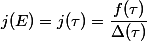


In the compactified fundamental domain, 


Cusp forms decay exponentially as we approach the cusp i.e. there are constants 


Combining these two inequalities, we get that

Since 
![\lvert j(\tau) \rvert \leq \exp([K:\mathbb{Q}] h(j(\tau))).](http://www.martinorr.name/blog/images/mathtex/1190.png)
By basic properties of heights, 
![\lvert 1 - j(\tau) \rvert \leq \exp \left(c_5 [K:\mathbb{Q}] \max(1, h(j(\tau))) \right).](http://www.martinorr.name/blog/images/mathtex/1192.png)
Hence
![\min(\lvert j(\tau) \rvert^{-1}, \lvert 1 - j(\tau) \rvert^{-1}) \geq \exp \left(-c_5 [K:\mathbb{Q}] \max(1, h(j(\tau))) \right).](http://www.martinorr.name/blog/images/mathtex/1193.png)
Combining the two bounds for ![c_1^{-1} c_2 \exp(- c_3 \mathop{\mathrm{Im}} \tau) \geq \exp \left(-c_5 [K:\mathbb{Q}] \max(1, h(j(\tau))) \right)](http://www.martinorr.name/blog/images/mathtex/1194.png)
![\mathop{\mathrm{Im}} \tau \leq c [K:\mathbb{Q}] \max(1, h(j(\tau))).](http://www.martinorr.name/blog/images/mathtex/1195.png)
This comment comes many years too late, but i found these notes quite helpful so wanted to contribute at least something: their proof is indeed independent of faltings proof. Milne was referring to another, much more subtle point about faltings heights within a K-isogeny class. The ineuqality, on the other hand, is a trivial consequence of looking at the definition in terms of the sum of volumes wrt a top form minus its index as a generator for top forms: Just pull back a neron form from B and use it for A. Note that both sides change by at most a constant multiple of logdeg f.