Maths > Abelian varieties > Absolute Hodge classes
Hodge classes on abelian varieties
Posted by Martin Orr on Monday, 25 August 2014 at 18:50
In this post I will define Hodge classes and state the Hodge conjecture. I will restrict my attention to the case of abelian varieties and say the minimum amount necessary to be able to discuss the relationships between the Hodge, Tate and Mumford-Tate conjectures and absolute Hodge classes in subsequent posts. There are many excellent accounts of this material already written, which may give greater detail and generality.
Hodge classes are cohomology classes on a complex variety 


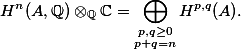

Note: Hodge classes are usually defined as living in the Tate twist 

Hodge structures and  of an abelian variety
So far in this blog, I have talked a lot about the homology group  of an abelian variety and its Hodge structure.
I also briefly mentioned the cohomology group
of an abelian variety and its Hodge structure.
I also briefly mentioned the cohomology group  when talking about Hodge symplectic forms.
Now I need to talk about the cohomology groups
when talking about Hodge symplectic forms.
Now I need to talk about the cohomology groups  in general.
Let's start with  , which is the dual of
  .
Recall that is a free
.
Recall that is a free  -module of rank
  .
The Hodge decomposition
.
The Hodge decomposition


 .
.
We could call this type of structure an -Hodge structure.
(The precise definition is the  case of the definition below.)
It is also known as an effective -Hodge structure of weight
case of the definition below.)
It is also known as an effective -Hodge structure of weight  .
.
Hodge structures and higher cohomology of abelian varieties
We can generalise the above concept to an effective -Hodge structure of weight  .
This is defined to be a finite-rank -module
.
This is defined to be a finite-rank -module  together with a decomposition into complex vector spaces

 for all
  and
and  .
(The word effective means that we only have pieces
.
(The word effective means that we only have pieces  where
where  .
The words weight mean that for every piece,
.
The words weight mean that for every piece,  .)
.)
The importance of this concept comes from the fact that for every smooth projective complex variety  (and more generally for every compact Kähler manifold, which includes all complex tori), the cohomology group
  comes with an effective -Hodge structure of weight .
I will not discuss the general construction here, but I will discuss what these Hodge structures are in the case of abelian varieties.
comes with an effective -Hodge structure of weight .
I will not discuss the general construction here, but I will discuss what these Hodge structures are in the case of abelian varieties.
The complex abelian variety is homeomorphic to the product of circles.
Basic topology gives us that the cohomology groups are the exterior powers of :

Given an effective Hodge structure  of weight , we can make its -th exterior power into an effective Hodge structure of weight by using the decomposition

 of an abelian variety.
Hodge classes
Let us consider the intersection

 , where we called elements of this intersection Hodge symplectic forms.
If  then this intersection is
  .
This is because each element of
.
This is because each element of  is fixed by complex conjugation, so

 is zero whenever because
  and the Hodge decomposition is a direct sum.
On the other hand, when  , we have
  and so
  may be non-zero.
We call elements of integral Hodge classes of weight
may be non-zero.
We call elements of integral Hodge classes of weight  .
.
In an earlier post, we essentially defined a Hodge symplectic form to be an integral Hodge class of weight 2. Hence the existence of a polarisation (a Hodge symplectic form satisfying a positivity property) guarantees that an abelian variety possesses a non-zero integral Hodge class of weight 2. The group of integral Hodge classes of weight 2 is known as the Neron-Severi group and its rank, called the Picard number, is an interesting invariant of the abelian variety.
In these blog posts, it will be more convenient to work with
 .
(Sometimes people call these elements rational Hodge classes, and use the term Hodge class to mean what we call an integral Hodge class.)
.
(Sometimes people call these elements rational Hodge classes, and use the term Hodge class to mean what we call an integral Hodge class.)
Algebraic cycle classes and the Hodge conjecture
The Hodge conjecture is not part of the main things I intend to write about in this blog, but I feel that I should not talk about Hodge classes without mentioning it briefly. It also provides motivation for some of the things we do with Hodge classes, and indeed give one reason why we care about Hodge classes in the first place.
Let be any smooth projective complex variety.
If  is a complex algebraic subvariety of codimension , then we can use Poincaré duality to define a class
  in
in  .
It turns out that is always an integral Hodge class.
.
It turns out that is always an integral Hodge class.
A class in  is called an algebraic cycle class if it is in the -span (or sometimes the -span) of those classes of the form .
The Hodge conjecture states that every Hodge class is an algebraic cycle class.
is called an algebraic cycle class if it is in the -span (or sometimes the -span) of those classes of the form .
The Hodge conjecture states that every Hodge class is an algebraic cycle class.
Hodge conjecture. The classes
.
Hodge classes and the Mumford-Tate group
We can give a characterisation of Hodge classes using the Mumford-Tate group. The key reason why this is important is that there is a sort of converse which I will discuss in a subsequent post, using Hodge classes to characterise the Mumford-Tate group.
Let us recall the definition of the Mumford-Tate group.
Associated with the -Hodge structure  , there is a group homomorphism
 such that
  acts as multiplication by
  on
on  and by
  on
on  .
The Mumford-Tate group of is defined to be the smallest algebraic subgroup
.
The Mumford-Tate group of is defined to be the smallest algebraic subgroup  defined over and such that
  contains the image of
  .
.
For each , there is a standard representation of  on
on  .
We can compose these with from the previous paragraph to get homomorphisms
.
We can compose these with from the previous paragraph to get homomorphisms

 acts as multiplication by
  on
on  .
.
Hence  is the subspace of
  on which
  acts as
  for all
  .
.
We would like to state this in terms of the Mumford-Tate group instead of , so we proceed as follows.
The image of (and hence also the Mumford-Tate group) is contained in the group  consisting of elements which preserve the symplectic form
  associated with a chosen polarisation (up to scalars).
There is a character
associated with a chosen polarisation (up to scalars).
There is a character  defined by

The fact that is a Hodge symplectic form implies that  .
So
.
So  acts on as multiplication by
  .
.
For each Hodge class  of weight , consider the algebraic group
 , and by the above its real points contain the image of .
Hence
, and by the above its real points contain the image of .
Hence  contains the Mumford-Tate group of , and thus all of
  acts on
  as multiplication by
  .
.
On the other hand, if we have some  which is an eigenvector for all of , then it must in particular be an eigenvector for
  .
We know that the eigenspaces of on
.
We know that the eigenspaces of on  are precisely the pieces of the Hodge decomposition, and the only such piece which can intersect is
  .
Thus any eigenvector for must be a Hodge class.
.
Thus any eigenvector for must be a Hodge class.
We deduce that
Proposition. A class in