Naturality in the Yoneda lemma for groups
Posted by Martin Orr on Saturday, 16 May 2009 at 19:54
In my last post on the Yoneda lemma for groups, I ignored the naturality part of the lemma. I want to work in detail what this means once - it is a lot of fiddly composing of morphisms and I probably won't do it again (at least in public). If you're not in the mood for following such details, then there is little point in reading this, although you could skip to the last paragraph.
First consider "natural in x". To explain what it means for the Yoneda map to be natural, we have to view both sides of the map themselves as functors C -> Set. For each object x the Yoneda lemma gives a function 

When interpreting each side of the Yoneda map as a functor, the expression which appears in the definition of 

For the LHS, it is more complicated (but there is only one thing to do). The object map takes 

"precompose with f" for each z in C

then
"precompose each component with".


(Note that we reversed direction, then back again.)
Let's get concrete and apply this to groups. Let T be a functor 


Recall that 


The naturality says that the following diagram commutes:
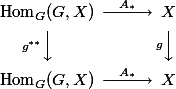
which is true since 
To interpret the phrase "natural in T" in the Yoneda lemma, we have to fix x and consider both sides as functors of T. The domain category is now D = { functors
In the case where C is a group category, D is just the category of G-sets and G-homomorphisms. The LHS is the functor 


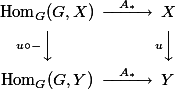
In other words, the function 

To summarise, the "natural in x" tells us that, for a fixed G-set X, the Yoneda map is itself a G-homomorphism 